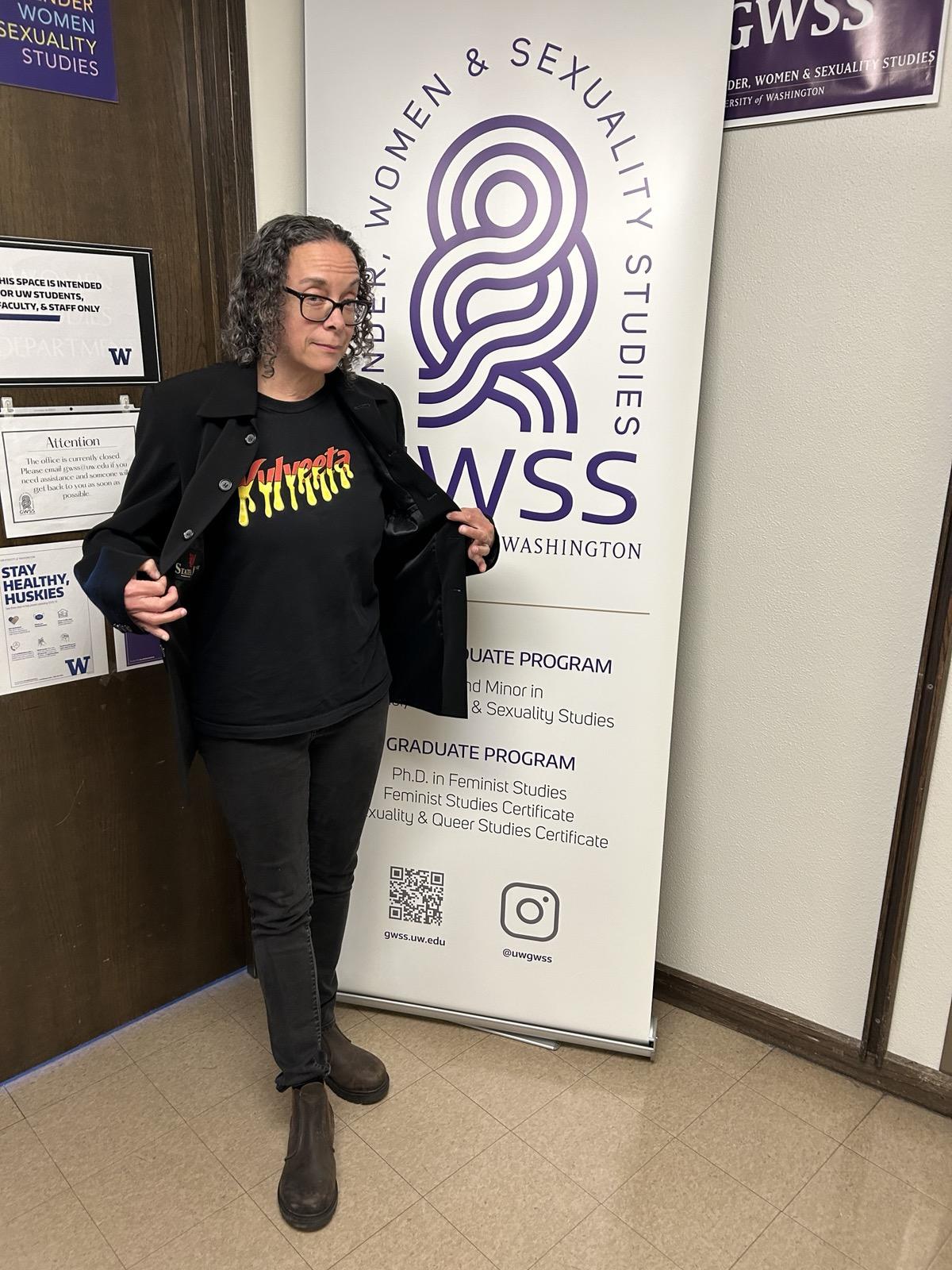
Our department recently partnered with Cinema & Media Studies to bring director Maria Breaux to campus for a screening of and conversation about their 2022 film, Vulveeta. This improvised mockumentary follows Grrrilda Beausoleil as she attempts to reunite her 1990s riot grrrl band. Beausoleil didn’t leave the band on very good terms, and she attempts to reunite with them amidst long-standing personal tensions and against the backdrop of a rapidly changed city.
The screening brought together a cross-generational audience of students, faculty, and members of the public for two hours of laughter—mainly, at the egotistical strivings of a punk rock diva trying to get the band back together and the antics that ensue. Montanna Lovins, writing for the student newspaper, The Daily, captured the film’s spirit well: “Everyone was hilariously hyperbolic, from their actions to their clothes. There’s very little as exciting to me as watching queer people get to be ridiculous and have fun with one another, and that is exactly what ‘Vulveeta’ delivered.”
In the Q&A, Maria talked about how viewing the film again was like a portal to the “before times,” before the pandemic, before Trump 2.0, and before the death of her brother David Breaux, AKA the Compassion Guy. Vulveeta was crowd-funded and shot entirely in San Francisco in 2019, with a cast drawn from the city's riot grrrl, indie rock, and punk scenes, including Lynn Breedlove of the legendary band Tribe 8. After editing delays caused by the pandemic, it began screening at film festivals in 2022. Remembering the fun and funny of making art together lends hope during hard times.
There’s nothing like sharing a moment of communitas with friends and strangers in a darkened theater before emerging into the bright light of the chaotic present to remind one why showing up matters. Showing up, that is, for art and for raging against the machine of technocapitalism and heteronormativity, for creative aspiration and for one another amid all our failures and imperfections.
The film, both in what it depicts and in how it was made, documents the kind of radical collaboration that runs through queer and feminist histories. Our own cross-campus partnerships feel like a small continuation of that tradition.